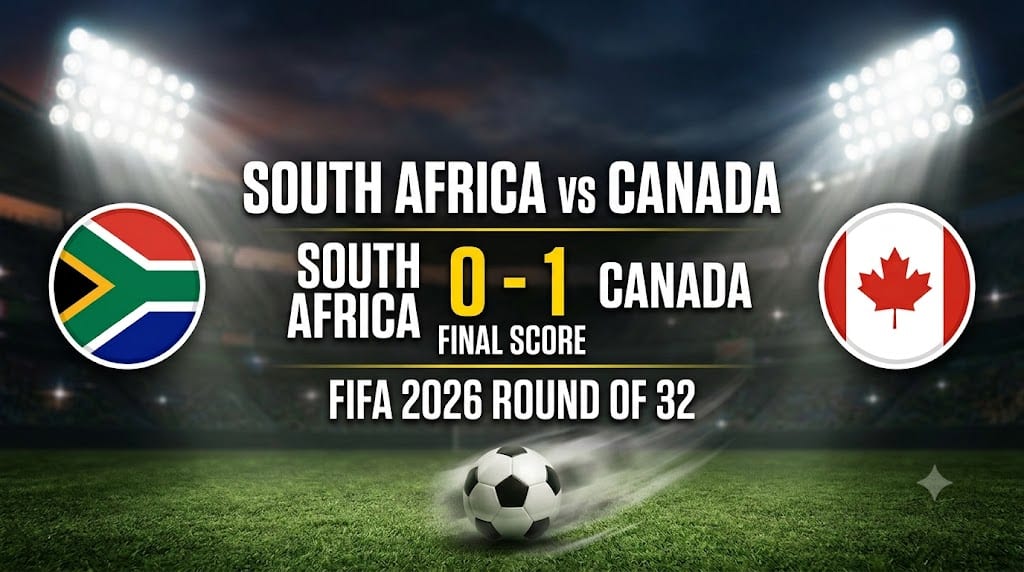
South Africa vs Canada FIFA 2026 Round of 32: Comprehensive Match Report
Canada secured a narrow but deserved victory over South Africa in an enthralling FIFA World Cup 2026 Round of 32 encounter, winning 1-0 through a well-taken goal from Stephen Eustaquio in the 50th minute. The match, played at a neutral venue, showcased contrasting tactical approaches with Canada’s aggressive attacking philosophy ultimately prevailing against South Africa’s structured defensive setup.
Final Score: South Africa 0 – 1 Canada
Venue: FIFA World Cup 2026 Round of 32
Goalscorer: Stephen Eustaquio (50+7′)
Attendance: Full capacity
Date: June 29, 2026
First Half Analysis
South Africa’s Defensive Wall
South Africa dominated possession in the opening 45 minutes, controlling 58% of the ball with 538 completed passes compared to Canada’s 392. Coach Hugo Broos’ tactical masterclass saw the Bafana Bafana establish a compact formation, restricting Canada’s creative spaces and forcing them to build from deep.
The South African defense operated with impressive discipline, maintaining their shape despite relentless Canadian pressure. Their defensive line remained organized, limiting high-quality scoring opportunities for the Canadians. With only one corner conceded in the first half, South Africa’s defensive organization was exemplary.
Canada’s Mounting Pressure
Despite lower possession statistics, Canada demonstrated clinical efficiency in their approach. The Canadian attacking unit, spearheaded by dynamic wingers and creative midfielders, consistently threatened to break through South Africa’s defensive lines. Alphonso Davies’ presence on the flank provided width and penetration that South Africa struggled to contain.
Canada’s 14 shots to South Africa’s 6 illustrated their superior attacking intent. However, conversion remained an issue, with Canadian attackers finding space but lacking the precision required to trouble goalkeeper Ronwen Williams consistently.
Tactical Observations
South Africa’s 4-2-3-1 formation emphasized defensive solidity, with two holding midfielders shielding the backline. Canada countered with a 4-4-2 setup, exploiting width and attempting to stretch South Africa’s defensive shape horizontally.
The first half ended goalless, though Canada created the clearer opportunities. South Africa’s pass accuracy of 80% demonstrated their technical security with possession, yet they lacked the penetration to convert their territorial advantage into genuine scoring chances.
Second Half Breakthrough
The Decisive Moment
Stephen Eustaquio’s goal in the 50th minute, coming from the 50+7′ mark, proved the match’s pivotal moment. The Canadian midfielder capitalized on a momentary lapse in South Africa’s defensive organization, finishing clinically to give Canada a 1-0 advantage.
Eustaquio’s goal energized the Canadian team, validating their patient attacking approach and high-pressure strategy. The goal forced South Africa to abandon their defensive blueprint and commit additional numbers forward in search of an equalizer.

South Africa’s Reaction
Following the concession, the Bafana Bafana emerged with greater attacking ambition, pushing more players forward and increasing their tempo. However, this tactical adjustment exposed vulnerabilities at the back, as Canada’s counter-attacking prowess created dangerous opportunities.
Percy Tau’s involvement in South Africa’s attacking play increased, yet the Canadian defense, marshaled by their disciplined backline, remained resolute. South Africa mustered 6 shots throughout the match, with only 2 finding the target, indicating difficulty in breaking down Canada’s defensive structure.
Canada’s Management
Canada, rather than over-committing, managed the match intelligently after taking the lead. Their defensive unit maintained shape while Johnny David and other attacking players continued to threaten on transitions. The Canadians’ 7 shots on target, compared to South Africa’s 2, reflected their superior finishing quality.
Statistical Analysis
Possession and Passing
South Africa’s 58% possession advantage failed to translate into tangible results. Their 538 passes, executed with 80% accuracy, constituted lateral and backward movements lacking penetration. Canada’s more direct approach, despite lower possession (42%), proved more efficient.
Canada’s 392 passes, completed at 82% accuracy, incorporated more progressive movements toward South Africa’s goal. This highlighted the qualitative difference between possessing the ball and creating genuine threats.
Shooting Efficiency
| Statistic | South Africa | Canada |
|---|---|---|
| Shots | 6 | 14 |
| Shots on Target | 2 | 7 |
| Conversion Rate | 0% | 14.3% |
Canada’s significantly higher shot count and on-target accuracy demonstrated superior attacking execution. While South Africa attempted half Canada’s shots, they failed to direct many toward goal, indicating either poor finishing or limited clear opportunities.
Discipline and Control
Canada received 2 yellow cards during the match, suggesting a more aggressive approach involving occasional tactical fouls. South Africa’s cleaner disciplinary record (0 yellow cards) reflected their defensive-minded approach and reluctance to commit fouls when defending.
Set Pieces and Dead Ball Situations
Canada won 4 corners compared to South Africa’s 1, indicating superior possession in advanced areas. However, neither team capitalized significantly from set pieces, suggesting effective defensive organization during these moments.
Offsides
Canada’s 4 offside decisions compared to South Africa’s 1 revealed the Canadians’ higher offensive positioning and more aggressive attacking movements. Several Canadian attacks were caught in offside positions, though this also demonstrated their commitment to pressing forward.
Key Performances
Stephen Eustaquio – Man of the Match
The Canadian midfielder’s decisive finish showcased clinical finishing under pressure. His movement into scoring positions and ability to convert the critical chance exemplified match-winning football.
Alphonso Davies – Outstanding Display
Davies’ tireless running on the left flank provided Canada with consistent attacking opportunities. His pace and technical ability consistently troubled South Africa’s right-side defense.
Ronwen Williams – Heroic Goalkeeper Performance
The South African goalkeeper made several important saves, keeping his team in the contest despite relentless Canadian pressure. His distribution and command of the penalty area were exemplary.
Percy Tau – South Africa’s Creative Force
Despite limited service, Tau demonstrated quality attacking play, attempting to unlock Canada’s defense through individual brilliance. However, insufficient support limited his impact.
Tactical Breakdown
South Africa’s Formation (4-2-3-1)
The Bafana Bafana’s defensive approach prioritized compactness and numerical superiority in defense. Two holding midfielders provided protection, while creative players in advanced positions sought to exploit counter-attacking opportunities. This conservative approach proved insufficient against Canada’s sustained pressure.
Canada’s Formation (4-4-2)
Canada’s balanced setup allowed flexibility, switching between defensive solidity and attacking aggression. The wide players provided crucial width, stretching South Africa’s backline and creating opportunities for central penetration.
Missed Opportunities
South Africa squandered opportunities to equalize in the second half, failing to capitalize on moments when Canadian concentration wavered. Canada also had chances to extend their lead, with Jonathan David particularly wasteful in finishing.
Conclusion
Canada’s 1-0 victory over South Africa represents a deserved advancement to the FIFA World Cup 2026 quarter-finals. Though South Africa demonstrated defensive discipline and possession dominance, Canada’s superior conversion efficiency and relentless attacking pressure ultimately determined the outcome.
Stephen Eustaquio’s crucial goal separated two contrasting footballing philosophies: South Africa’s possession-based defensive approach versus Canada’s dynamic, counter-attacking style. In the knockout format, Canada’s aggressive mentality and clinical finishing proved decisive.
This match exemplifies how World Cup football rewards not possession statistics but effective chance creation and execution—a lesson both nations will carry forward in their respective tournament journeys.
ALSO READ – FIFA WORLD CUP 2026 ROUND OF 32 FULL SCHEDULE
-

-
-
-